
DevelopingForeignTimeline
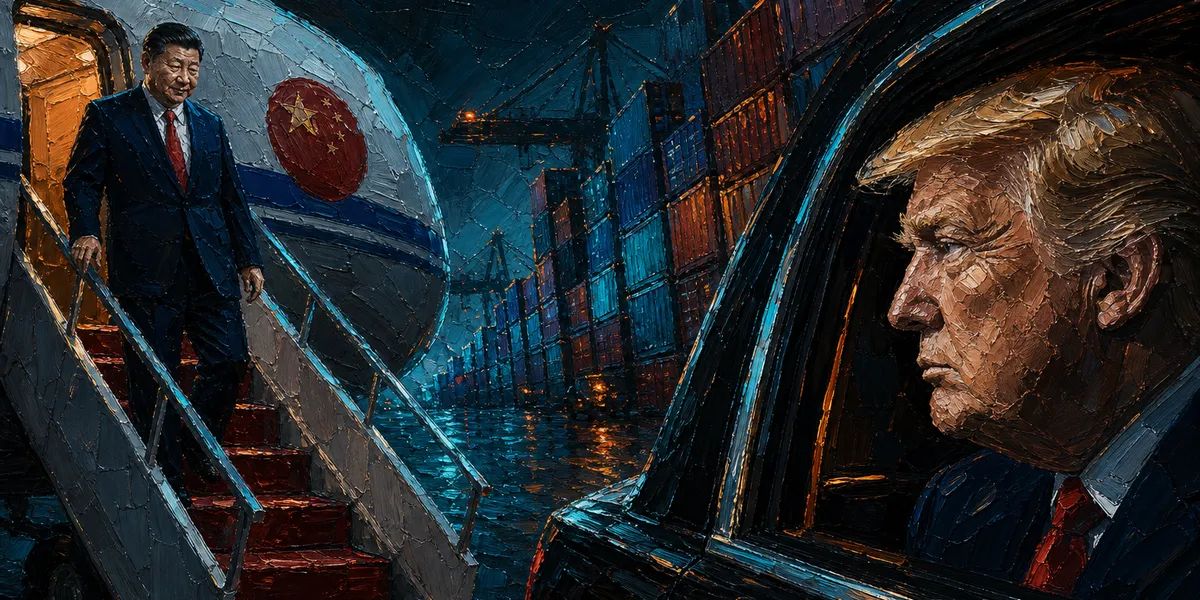
Donald Trump's 2026 China State Visit
Updated 7 updatessince 75 outlets
The ongoing saga details U.S. President Donald Trump's high-stakes diplomatic engagement with Chinese President Xi Jinping, focusing on topics like trade and artificial intelligence, with recent meetings shaping relations.
Timeline
Now
U.S. President Donald Trump met with Chinese President Xi Jinping in Washington on September 23, 2026.
11 sources · CNBC, NPR
During preparatory talks in New York, U.S. Treasury Secretary Scott Bessent proposed a new mechanism for the U.S. and China to share notifications about AI incidents that could threaten national security.
21 sources · Reuters, Al Jazeera
Xi Jinping will pay a state visit to the United States from September 23 to 25 at the invitation of President Donald Trump.
36 sources · New York Times, Reuters
Trump and Xi Set to Discuss AI
EscalationU.S. President Donald Trump and Chinese President Xi Jinping are scheduled to meet next week, with their discussions focusing on critical topics such as artificial intelligence, trade tariffs, and supply chains.
10 sources · ABC News, CNBC
President Donald Trump left Beijing after a two-day summit with Xi Jinping, claiming a tonal reset in relations but without any concrete achievements.
12 sources · New York Times, Reuters
During a state dinner in Beijing, U.S. President Donald Trump invited Chinese President Xi Jinping to visit the White House on September 24.
12 sources · Reuters, AP
U.S. President Donald Trump arrived at Beijing International Capital Airport on May 11, 2026 to begin the summit with Chinese President Xi Jinping. His arrival marked the start of the high-profile bilateral talks and associated diplomatic events in Beijing.
1 source · AP
- Origin May 11, 2026
The story so far
As of September 23, 2026
China has confirmed that Xi Jinping will make a state visit to the United States from September 23 to 25 at Donald Trump’s invitation. This will be their first meeting in Washington in a decade and follows Trump’s May trip to Beijing that softened the tone but produced few concrete results. The agenda is crowded with artificial intelligence, trade and supply chains, and security issues that could unsettle any progress.
The clearest sign of where the summit may land came in New York, where Treasury Secretary Scott Bessent and Vice Premier He Lifeng discussed a new way for the two governments to alert each other to dangerous AI problems that touch national security. They also moved to activate a new process, called the Board of Trade, to identify lower risk products on which both sides could cut import taxes. That matters because a pause on new tariffs between the two countries ends on November 10, and China’s shipments of rare-earth magnets to the U.S. fell last month, a data point that underscores U.S. concern that Beijing is still squeezing critical inputs for defense and tech manufacturing.
Everything else around the summit tightens the screws. Washington has banned Chinese humanoid robot imports; Beijing hit back with new controls on drone exports and restrictions on U.S. entities. The White House has labeled China a main source of chemicals used to make synthetic drugs, and Trump just signed new sanctions on Russia and Iran that could bite Chinese energy trade. Rumors of a U.S. arms package for Taiwan and a pending list of possible tariff cuts only on non sensitive goods show how narrow the space is for agreement.
So the story has turned into an effort to bolt minimal guardrails onto a rivalry. Beijing is pressing for what it calls strategic stability, which is a framework to constrain surprises, while the U.S. is trying to buy time to reduce dependence on Chinese minerals and keep tightening controls on advanced technology. The likely near term outcomes are mechanisms and timelines, not big deals: an AI incident alert channel, a short list of goods for tax relief, and a decision on whether to extend the tariff pause. Signals around the visit point to that focus, from planned attendance by AI chiefs Sam Altman and Jensen Huang at the state dinner to Trump’s separate coordination meeting with Japan’s Sanae Takaichi, and Xi prioritizing Washington over the United Nations to lock in bilateral terms.
Each entry is synthesized by AI from the reports linked on it, and labeled with the kind of change it represents. How Frameshift works · What the labels mean · Report an error
In the app
Read this timeline in Frameshift
Four stories are free on the web. The full Vault, with every timeline and brief, is in the app.