
DevelopingCrisisTimeline
NTSB Investigation Reveals Crash
Updated 3 updatessince 78 outlets
The saga centers on a midair collision involving a Pennsylvania State Police helicopter and a Cessna 150, resulting in the death of pilot Paul Sokoloski and injuries to two troopers. Investigations are ongoing.
Timeline
Now
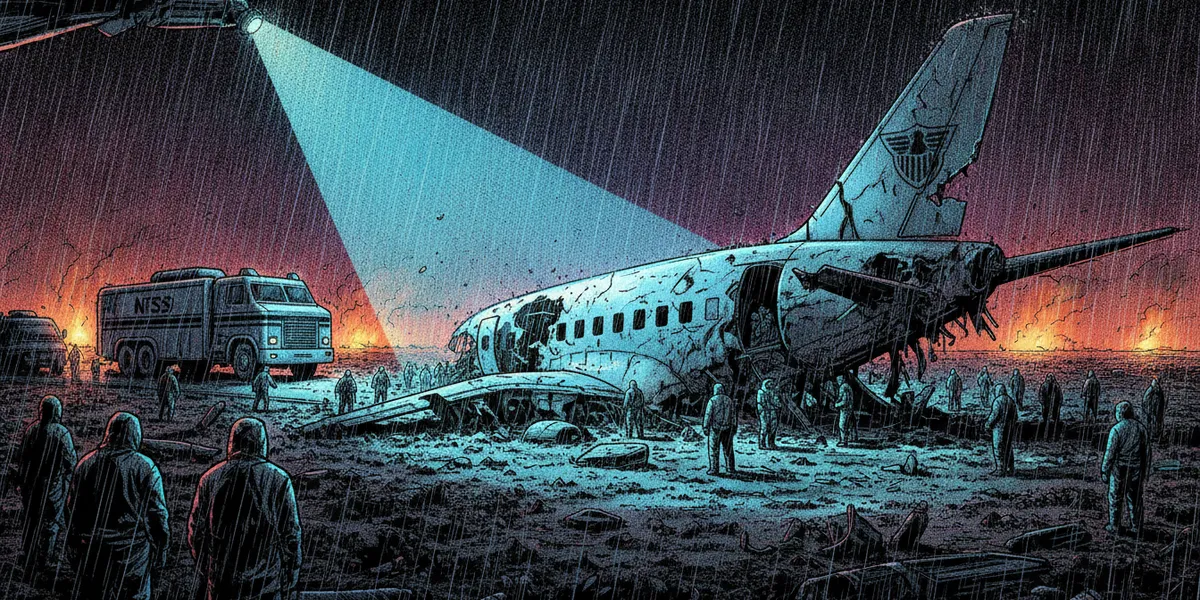
National Transportation Safety Board announced the start of its investigation into the crash, revealing aircraft system failures and unusual flight path behavior before the collision.
43 sources · CBS News, ABC News
Two Pennsylvania State Police troopers, Corporal Bryce Corman and Trooper Jason Mills, were injured in the midair collision with a Cessna 150.
23 sources · New York Times, ABC News
Paul Sokoloski, 57, of Hershey, Pennsylvania, has been identified as the pilot killed in the midair collision involving a Pennsylvania State Police helicopter and a Cessna 150 at Carlisle Regional Airport.
26 sources · New York Times, ABC News
- Origin Aug 19, 2026
The story so far
As of August 20, 2026
A Cessna 150 attempting to land at Carlisle Airport on Aug. 19 veered to the right and struck the tail of a Pennsylvania State Police Bell 407 that was hovering a few feet above a grassy area beside the runway during a training exercise. Both aircraft came down. The Cessna’s pilot, Paul William Sokoloski, 57, of Hershey, was killed. The helicopter pilots, Cpl. Bryce Corman and Trooper Jason Mills, were injured but got out of the overturned aircraft; Corman has since been released and Mills remains hospitalized in stable condition.
Investigators have opened the NTSB probe and are building the sequence from wreckage, airport surveillance video, and radio traffic at the non-towered field. Both aircraft were on the common frequency and had established communication, and evidence indicates the Cessna pilot was aware of the hovering helicopter. The Cessna’s approach was atypical: straight and level, then a sharp pitch-up, a left turn, a brief level-off, and impact into the rear of the helicopter. Early findings include aircraft system failures and an unusual flight path before the collision.
The core of the case has shifted from whether the crews saw each other to why expected separation failed in a setting that relies on see-and-avoid and radio coordination. Two instructor-rated pilots, good visibility, an announced hover-taxi near the runway, and an approach that changed abruptly put focus on three threads that explain the rest: the Cessna’s control and systems status after recent maintenance, the pilots’ actions and workload in the pattern, and how a training hover was positioned relative to a landing path at an uncontrolled airport.
What remains is a technical determination of cause. The wreckage is being moved to a secure facility for examination of airframes, powerplants, and control continuity, alongside a review of pilot performance and the operating environment. No fault finding has been made, and the NTSB’s analysis and probable-cause work will take months.
Each entry is synthesized by AI from the reports linked on it, and labeled with the kind of change it represents. How Frameshift works · What the labels mean · Report an error
In the app
Read this timeline in Frameshift
Four stories are free on the web. The full Vault, with every timeline and brief, is in the app.